 |
| September 9, 2014–January 4, 2015. |
Enchantment with the book, the movie,
the story of survival set against the backdrop of the Civil War and Reconstruction that followed, began for me when I first read Margaret Mitchell's book at
age 16––the same age as Scarlett O'Hara when the story begins.
Hadn't I already seen the movie? Yes.
Alert with a wide-eyed thrill of let's go to the movie, my mother had taken me to see Gone With the Wind when I was
4-years-old. Afterward, a vague recollection of holding her hand amidst a pressing crowd, I stumbled through the lobby following a lengthy nap.
Back when great films only reappeared in limited release
in select theaters, I saw the movie GWTW
for a second time during my high school senior year, inside a lavish BIG-screen
theater at Northpark, in Dallas, TX. Bowled over was I.
Christmas in September
 Reading about the restoration of some of the costumes and the planned GWTW exhibit a year ago, as soon as tickets became available, I looked forward to this trip to Austin as if waiting to unwrap a Christmas present. At the Harry Ransom Center on the campus of the University of Texas, September 5, 2014, my husband and I joined a few hundred invited guests to a preview
event that commemorates 75 years since
the release of the movie, Gone With the Wind.
Items selected from David O. Selznick's private collection, including the green curtain dress, display in chronological order the saga of making this epic film.
Today, Turner Classic Movies (TCM) offers regular showings on television, and copies of restored versions on VHS and DVD's make the film readily available. Still, for me, the thrill of watching, and talking about, GWTW has not gone.
Reading about the restoration of some of the costumes and the planned GWTW exhibit a year ago, as soon as tickets became available, I looked forward to this trip to Austin as if waiting to unwrap a Christmas present. At the Harry Ransom Center on the campus of the University of Texas, September 5, 2014, my husband and I joined a few hundred invited guests to a preview
event that commemorates 75 years since
the release of the movie, Gone With the Wind.
Items selected from David O. Selznick's private collection, including the green curtain dress, display in chronological order the saga of making this epic film.
Today, Turner Classic Movies (TCM) offers regular showings on television, and copies of restored versions on VHS and DVD's make the film readily available. Still, for me, the thrill of watching, and talking about, GWTW has not gone.
"My own true love"
This past week, I gave a program on "The
Making of Gone With the Wind" based on the Ransom Center exhibit. Information from several books about
the movie and about
Margaret Mitchell's novel and some notes from DVD extras that were included
in the 70th
Anniversary edition of the film supplement what I saw at the Austin exhibit.
Seizing this opportunity, I also paid tribute to the
parody, "Went With the Wind," performed on the Carol Burnett Show in 1976 by wearing my own green curtain
dress. Watch the YouTube video of the other Carol, not me. Still makes me laugh out loud.
 |
| Costume-in-progress |
 |
| Standing next to me is Miss Scarlett, the dress form |
How can a 75-year-old movie still captivate audiences?
David O.
 David
Selznick himself added the O to his name. A flourish, he liked the way the O made
his name sound. O could represent the producer’s magnificent obsession to make
a movie masterpiece. But along the way, DOS (how Selznick often signed telegrams
and memos) endured setbacks, criticism and jealousy as his enterprise earned
the name “Selznick’s Folly.”
David
Selznick himself added the O to his name. A flourish, he liked the way the O made
his name sound. O could represent the producer’s magnificent obsession to make
a movie masterpiece. But along the way, DOS (how Selznick often signed telegrams
and memos) endured setbacks, criticism and jealousy as his enterprise earned
the name “Selznick’s Folly.”
Days after
the novel's release in June, 34-year-old David O. Selznick purchased the movie
rights for $50,000. Yet more than 2 years would pass before filming began.
The
original Macmillan published release of Gone
With the Wind sold more than 176,000 copies, continuing to sell "at a furious rate," 1.7 million copies in a year, selling 50,000 copies in one day. Margaret Mitchell had hoped that the book would sell 5,000 copies "so they won't lose money."
In 1937, Margaret Mitchell won the Pulitzer for her
novel, further compounding Selznick’s anxiety and a sense of urgency that his film version capitalize on the novel’s success. He had more than a few days yet to tote the weary load of this monumental task.
 |
| A first edition of Margaret Mitchell's surprising best-seller |
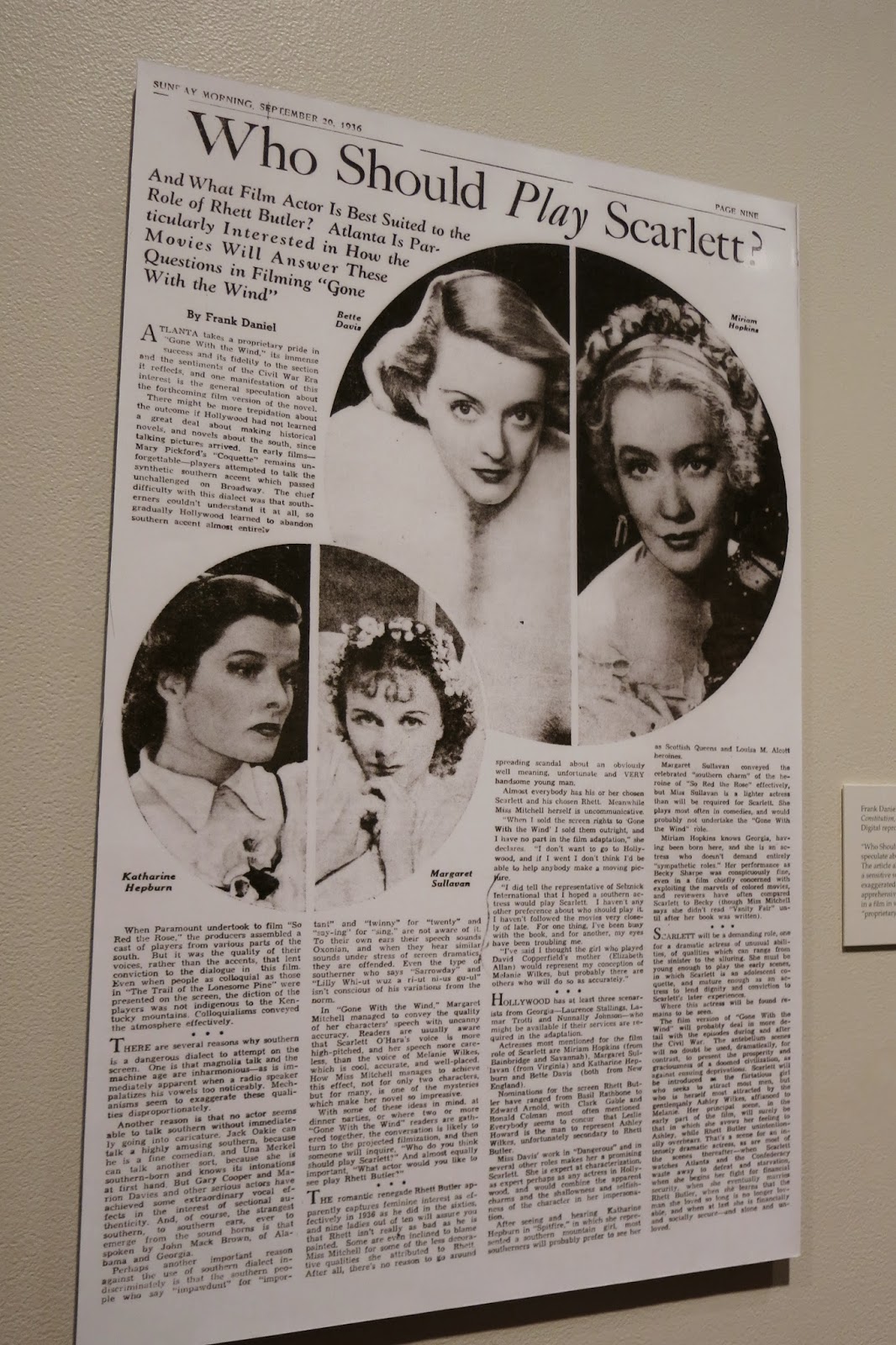 To
maintain public interest and secure free publicity for the film, Selznick's studio embarked on a nationwide search for the woman to play Scarlett O'Hara, a
search that played out in newspapers across the country. For possibly the most
coveted film role in history, stars and wanna-be-stars auditioned, wrote
letters and launched campaigns to attract attention. In all, Selznick conducted
1,600 screen tests before selecting his Scarlett.
To
maintain public interest and secure free publicity for the film, Selznick's studio embarked on a nationwide search for the woman to play Scarlett O'Hara, a
search that played out in newspapers across the country. For possibly the most
coveted film role in history, stars and wanna-be-stars auditioned, wrote
letters and launched campaigns to attract attention. In all, Selznick conducted
1,600 screen tests before selecting his Scarlett.
Vivien Leigh was there
On the
back-lot of the old RKO studio, known by then as Selznick International Pictures,
December 10, 1938, the first scene filmed showed the burning of Atlanta.
 |
| Production Designer William Cameron Menzies' designs for the burning of Atlanta |
In a dramatic scene that recreates Sherman's army's march through the South, Selznick captured on film the inferno that signaled all but the official end of America's Civil War. No re-takes for this spectacular,
stunt-filled scene.
Delapidated backlot sets burned as 7 Technicolor cameras rolled, making way for the 90 sets that would
be built for GWTW, using more than a
million feet of lumber. A virtual
fireworks display with Los Angeles area fire departments standing by, filming had begun.
David
O. had lit the match.
Rather than alert news outlets, calls from residents to police and fire departments brought media attention as people reported seeing an enormous blaze light the night sky.
After filming that pivotal scene, DOS had burned his first bridge. No turning back. Now he had to choose his Scarlett.
Another
publicity stunt, concocted for the press, Vivien Leigh with her newly signed
agent, Myron Selznick––David’s brother––and Lawrence Olivier, whom Leigh would
later marry, arrived just in time to watch sets from King Kong and Garden of Allah collapse.
Vivien Leigh's face that evening––a warm glow cast from the flames that burned––may have
given her the distinct advantage she needed to win the role of Scarlett. But contrary to the myth that this night was the first time Selznick had laid eyes on her, DOS had already met Miss Leigh, hidden her at the Beverly Hills Hotel, and planned her dramatic arrival to stage his so-called discovery of new-to-America talent.
The search for Scarlett narrowed to 4 actresses: Vivien Leigh, Paulette Goddard, Joan
Bennett, and Jean Arthur, who each made screen tests of the same 3
scenes. Goddard who had been favored early on to play Scarlett lost to the latecomer, British
actress Vivien Leigh.
 |
| Vivien Leigh |
 |
| Paulett Goddard |
Friday,
January 13, 1939, Selznick announced his
 |
| Signing contracts, January 13, 1939 |
selection of Vivien Leigh, along with
the rest of his cast, Clark Gable as Rhett, Olivia de Havilland as Melanie and
Leslie Howard as Ashley Wilkes. Official filming began January 26,1939.
Noting dates emphasizes the speed of production for what in
hindsight became a miraculous film achievement.
Script? What Script?
Screenwriter
Sidney Howard had managed to distill Margaret Mitchell’s story to a 6-hour script.
Had the novel been filmed as it was written, it would make a movie 168 hours
long. That translates to a week of 24/7 viewing time.
 |
| Colored pages reflect script changes |
Multiple
screenwriters, 2 Directors, daily script revisions, as well as scenes filmed
out of sequence, produced an unwieldy mess. Chaos and fatigue beset nearly
everyone involved with filming.
Selznick oversaw everything from production design, to costumes, to
issues of censorship and racial controversy, to hovering
over director George Cukor who was fired (or did he resign?) after 2 weeks, and then second-guessing replacement
director Victor Fleming. Fleming, who received screen credit for direction, also directed The Wizard of Oz that same year.
How did one man, DOS, keep up with
so many moving parts?
The
higgledy-piggledy filming of the movie would eventually consume 449,512 feet of
film––160,00 feet of film printed–– and 20,300 feet of film in the final film
with a running time of nearly 4 hours.
“Accurate
continuity didn’t exist except in [Selznick’s] head,” remarked someone close to
filming and post-production. David O. Selznick spent 4 intense months editing,
“a demented process,” this same source said, yet Selznick’s editing ability shone
in the finished film.
A “No
Press preview” in Riverside, CA, a 2-hour drive from Hollywood, stunned the
audience who thought they had come to the Fox Theater to see the movie Beau Geste.
When told this audience could not leave once the movie began, their thunderous
applause erupted as curtains opened to a framed still:
“David
O. Selznick’s Gone With the Wind.”
The movie had no titles or its own yet-to-be written by Max Steiner score for the soundtrack
(The Prisoner of Zenda soundtrack played instead), yet this one and only preview audience
saw the long-awaited movie Selznick managed to film in 125 days, and complete in time for the 1939 Academy
Awards.
In part 2, read about Clark Gable and the line that could have caused the end of the movie to fizzle.
[Note: Photography at the exhibit was permitted and the photos posted here were taken with my Canon G15 camera.]
 Seated near the back of the high school auditorium, stage right under a balcony, when the announcer called my name, I was as overwhelmed and mystified as any Academy Award winner.


